How Happy are you?
We’ve been told we’re in the middle of a happiness crisis, but I don’t buy that. What I see clinically, and what I’m experiencing in real time with patients and audiences, is something far more precise. This is a dopamine crisis. And until we start calling it that, we’re going to keep chasing solutions that never actually resolve the problem.
Dopamine is not happiness. It never was. Dopamine is drive. It’s the internal signal that pushes you to act, to pursue, to build, to repeat behaviors that move your life forward. It’s what gets you out of bed in the morning, not what makes you feel satisfied at the end of the day. And right now, that system is being overwhelmed and diluted at the same time.
Modern life has created a perfect storm where dopamine is constantly triggered but rarely earned. Every notification, every scroll, every hyper-palatable food delivers a spike. But without effort attached to that signal, it becomes meaningless. Over time, the brain adapts. It always does. It starts reducing receptor sensitivity, almost like turning down the volume on a speaker that’s been blasting too loud for too long. Now the same level of stimulation doesn’t land the way it used to. Things that once felt engaging feel flat. Motivation drops. Focus fragments. And the instinct is to reach for more stimulation to compensate.
At the same time, I’m seeing another pattern layered on top of that. Chronic stress and burnout are depleting dopamine production itself. So now you have a system that is both overstimulated and under-fueled. You’ve got the receptors, but not enough signal. Or you’ve got the signal, but not enough receptors. Either way, the experience is the same. You feel wired but tired. Busy but unproductive. Constantly engaged but rarely fulfilled.
Biology vs Willpower
We’ve normalized environments that hijack dopamine. Phones that never stop. Infinite content streams. Foods engineered to light up reward pathways without delivering real nourishment. These inputs train the brain to expect high levels of stimulation without effort, and in doing so, they disconnect the fundamental relationship between action and reward. And its this relationship which is everything.
Because dopamine behaves very differently depending on how it’s generated. When it’s earned through effort, it reinforces behavior in a way that builds resilience, focus, and long-term motivation. When it’s passively consumed, it weakens the system. It lowers your threshold for stimulation and makes real-world effort feel harder than it should.
I often frame this as the difference between the pursuit of happiness and the happiness of pursuit. One is about chasing the next hit. The next distraction. The next quick reward. The other is about engaging in something that requires effort. Learning, training, creating, building. One depletes you over time and the other restores you. It is very biochemical.
Dopamine is synthesized from the amino acid L-tyrosine, which means your diet plays a direct role in your ability to produce it. But production is only part of the equation. Utilization, receptor sensitivity, and behavioral patterns determine whether that dopamine actually translates into motivation and drive.
Genetics absolutely influence this system. Some people are wired to clear dopamine faster. Some are more sensitive to stimulation. Some have fewer receptors to begin with. But what I want to be very clear about is this. Genetics set the tone. Lifestyle writes the story.
So when people ask me how to reset dopamine, they’re usually looking for a shortcut. A hack. A supplement that overrides the system. That’s not how this works because you don’t hack dopamine… you rebuild the system!
And rebuilding it requires structure. Structure in how you spend your time. Structure in how you engage with effort. Structure in how you fuel your brain and body. When you start to remove constant stimulation, reintroduce effort-driven activities, and support the biology underneath it all, the system begins to recalibrate. And when it does, a few things shift including how motivation stops being something you chase and it becomes something you generate.
Rebuilding a High Functioning Dopamine System
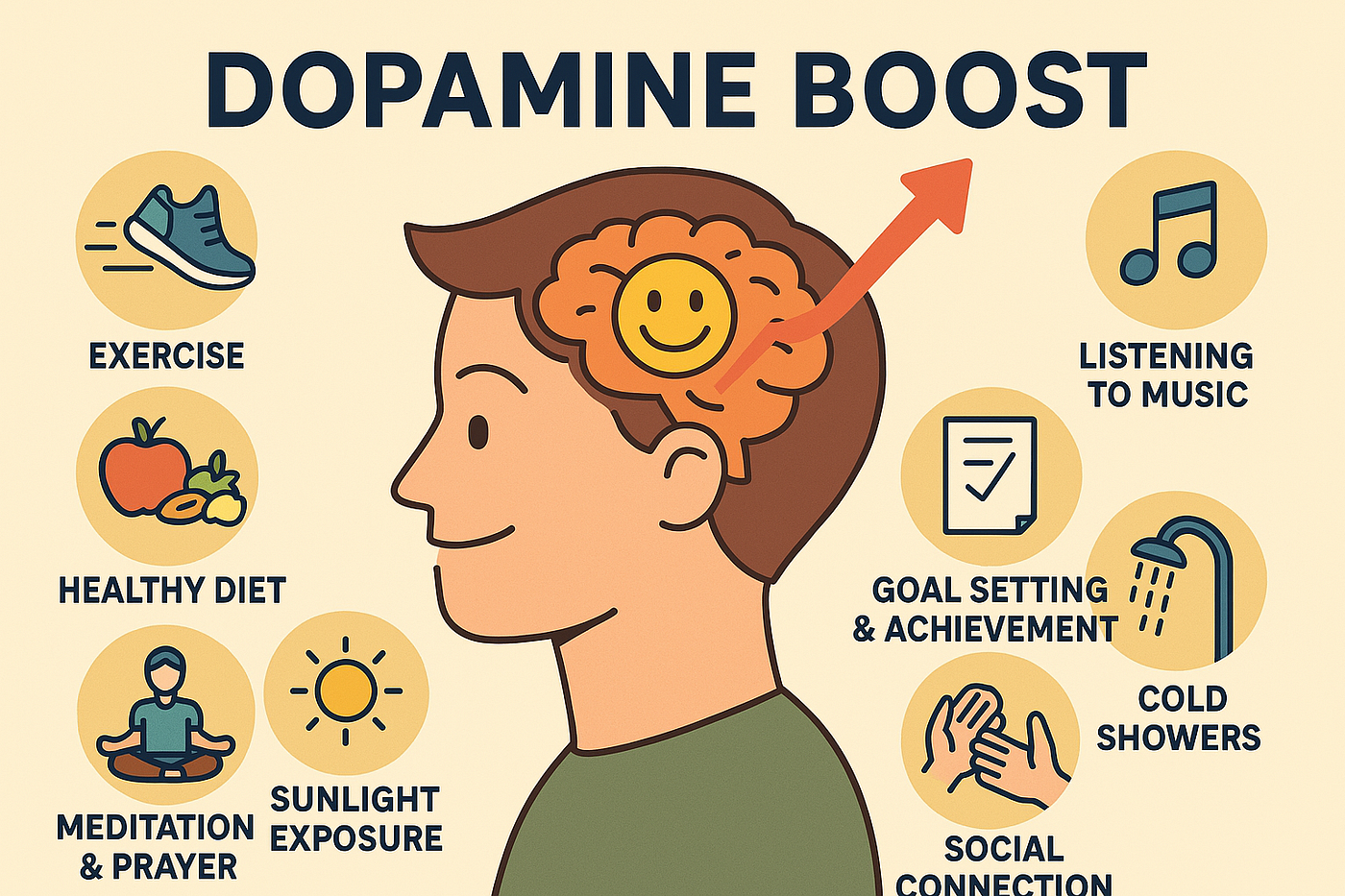
Start with removing the constant noise. Create at least one to two hours per day where there is no passive stimulation. No scrolling, no notifications, no background input. This is how receptor sensitivity begins to recover.
Anchor your day with effort driven dopamine. This means one non negotiable activity that requires exertion. Strength training, interval training, or even a long walk with intention. The key is effort before reward.
Stack small wins early. Create a short list of tasks that can be completed within the first two hours of your day. Completion drives dopamine far more effectively than anticipation.
Prioritize sleep consistency. Dopamine receptor sensitivity is directly tied to circadian rhythm stability. Wake time matters more than bedtime.
Dopamine Supporting Foods
Focus on foods rich in L tyrosine and phenylalanine, as these are the direct building blocks for dopamine synthesis.
Eggs, particularly the yolks, provide a dense source of tyrosine along with choline for neuronal signaling
Grass fed beef and poultry supply high levels of bioavailable amino acids critical for neurotransmitter production
Wild caught fish supports dopamine through both protein and omega three fatty acids which enhance receptor function
Pumpkin seeds and sesame seeds are among the most concentrated plant based sources of tyrosine
Almonds and walnuts contribute both amino acids and polyphenols that support neuronal resilience
Fermented dairy such as Greek yogurt or kefir provides tyrosine alongside gut microbiome support which influences dopamine signaling
Avocado supports dopaminergic neurons through healthy fats and cofactor nutrients
Bananas contain small amounts of dopamine precursors and support overall neurotransmitter balance
Fava beans are a unique addition here because they contain natural L DOPA, which sits one step closer to dopamine in the synthesis pathway than L tyrosine. That makes them one of the few whole foods that can more directly support dopamine production, particularly in individuals who are depleted or under chronic stress. In a clinical context, they can be useful for gently supporting motivation and drive, but they should be used thoughtfully, especially in those who are sensitive to dopamine fluctuations. (avoid if taking levodopa for Parkinsons!)
Targeted Supplements That Boost Dopamine
L Tyrosine
500 to 1500 mg in the morning on an empty stomach
Supports dopamine synthesis directly, particularly in states of stress or cognitive demand
Rhodiola rosea
200 to 400 mg standardized extract early in the day
Improves stress resilience and preserves dopamine under chronic stress conditions
Vitamin B6 as Pyridoxal 5 Phosphate
25 to 50 mg daily
Essential cofactor for conversion of L DOPA to dopamine
Magnesium glycinate
200 to 400 mg in the evening
Supports receptor sensitivity and reduces stress driven dopamine depletion
Omega 3 fatty acids with higher EPA ratio
1000 to 2000 mg daily
Enhances dopamine receptor fluidity and signaling efficiency
Mucuna pruriens extract standardized for a direct L-DOPA hit
100 to 300 mg L DOPA equivalent in the morning
Provides a more direct upstream substrate for dopamine production in depleted states (but avoid if taking levodopa for Parkinsons!)
The goal is not to chase dopamine hits, but rather to rebuild a system that rewards effort, progress, and meaning. Because when dopamine is functioning correctly, motivation is not something you force. It is something that naturally emerges from how you live this life.